Canning methods
Water-Bath vs. Pressure Canning: Which Do You Need?
How to tell which home canning method a food needs, how each canner works, and what to look for when you buy one, based on USDA and NCHFP guidance.
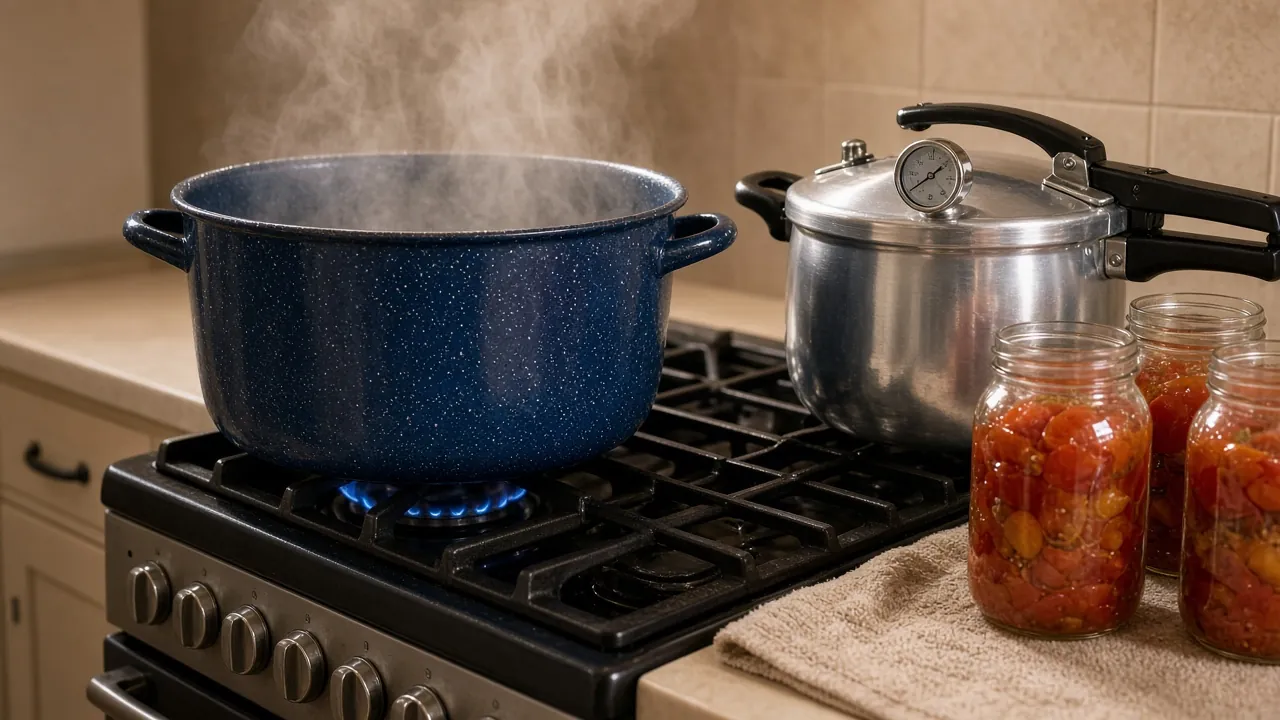
Every home-canning question eventually comes back to one fork in the road: does this food go in a boiling-water canner or a pressure canner? The answer isn't a matter of taste or tradition. It's set by the acidity of the food, and getting it wrong with low-acid foods can be dangerous. This guide explains the rule, how each canner works, and what to look for when buying one.
Everything about safety here comes from the USDA Complete Guide to Home Canning (Agriculture Information Bulletin No. 539) as published by the National Center for Home Food Preservation (NCHFP) at the University of Georgia. We link the exact page for each point so you can check it yourself.
The short answer
- Acid foods (pH 4.6 or lower) can be processed in a boiling-water canner. NCHFP lists fruits, pickles, sauerkraut, jams, jellies, marmalades and fruit butters here, and tomatoes and figs only when acidified with lemon juice or citric acid as a tested recipe directs.
- Low-acid foods (pH above 4.6) must be processed in a pressure canner. That covers red meats, seafood, poultry, milk and all fresh vegetables except most tomatoes. Most mixtures of low-acid and acid foods (soups, many sauces) are also low-acid unless the recipe adds enough acid.
The non-negotiable ruleUse a current, research-tested recipe and follow its method, jar size, headspace, processing time and altitude adjustment exactly. The safety comes from the tested process, not from the equipment alone.
Why acidity decides the method
The concern is Clostridium botulinum, the bacterium behind botulism. NCHFP explains that its spores are present on most fresh food surfaces and are harmless while exposed to air. Inside a sealed jar, the conditions can suit them: a moist, low-acid food, a temperature between 40°F and 120°F, and less than 2 percent oxygen. Under those conditions the spores can produce cells that make a deadly toxin within 3 to 4 days of growth (NCHFP: Ensuring Safe Canned Foods).
Acid blocks their growth. That's why acid foods can be processed at the temperature of boiling water, while low-acid foods can't. NCHFP notes that botulinum spores are very hard to destroy at boiling-water temperatures, so low-acid foods need 240°F to 250°F, which home cooks can only reach with a pressure canner run at 10 to 15 pounds per square inch (PSI). To put that in perspective, the USDA guide says safely processing low-acid foods in boiling water would take 7 to 11 hours, which is why no tested recipe does it.
Pressure isn't what kills bacteriaTemperature is. NCHFP is explicit: pressure is just the way to reach a higher temperature in pure steam. That's why venting air out of a pressure canner matters so much (more on that below).
Which foods go where
| Food group | Acidity | Method |
|---|---|---|
| Most fruits, fruit juices, fruit butters | Acid | Boiling-water canner |
| Jams, jellies, marmalades | Acid | Boiling-water canner |
| Pickles and relishes (tested vinegar ratios), sauerkraut | Acid / acidified | Boiling-water canner |
| Tomatoes, figs | Can be slightly above pH 4.6 | Add lemon juice or citric acid exactly as the tested recipe directs, then use its boiling-water (or tested pressure) process |
| Salsa | Mixture | Only a tested salsa recipe, with its specified acid |
| Green beans, corn, carrots, potatoes, other fresh vegetables | Low-acid | Pressure canner |
| Meat, poultry, seafood, stocks | Low-acid | Pressure canner |
| Soups and mixed vegetable dishes | Usually low-acid | Pressure canner, tested soup procedure only |
How a boiling-water canner works
A boiling-water canner is simply a deep pot with a fitted lid and a removable rack that keeps jars off the bottom. NCHFP's canner guidance sets the key requirements:
- Depth: the pot must be deep enough for at least 1 inch of briskly boiling water over the jar tops. For processes longer than 30 minutes, keep at least 2 inches over the jars.
- Bottom: on an electric range, use a flat-bottomed canner. Flat or ridged bottoms both work on gas.
- Width: on an electric range, the canner should be no more than 4 inches wider in diameter than the element, so all jars heat evenly.
The process in brief, per NCHFP:
- Put the rack in and fill the canner about halfway; preheat the water to 140°F for raw-packed foods or 180°F for hot-packed foods.
- Load filled, lidded jars upright with a jar lifter, then add hot water so it's at least 1 inch above the jar tops.
- Cover, heat on high until the water boils vigorously, and only then start the timer.
- Keep a full boil for the whole time. If the boil stops at any point, bring it back and restart the timing from the beginning.
- At the end, turn off the heat, remove the lid, wait 5 minutes, then lift jars out onto a towel with at least 1 inch between them. Let them cool undisturbed for 12 to 24 hours.
Expect a loaded canner to take about 20 to 30 minutes to come to a boil, and most acid-food processes run 25 to 60 minutes in total, according to the same NCHFP page.
How a pressure canner works
A modern pressure canner is a heavy pot with a locking lid, a rack, a dial or weighted gauge, a vent port, a vent/cover lock and a safety fuse (or overpressure plug). At sea level, NCHFP says a canner at a gauge pressure of 10.5 lbs gives an internal temperature of 240°F.
Two things can quietly lower that temperature: higher elevations, and air trapped inside the canner. That's why every pressure canner must be vented for 10 minutes before pressurizing. The steps from NCHFP:
- Check the canner first: clean gasket and parts per the manual, and make sure vent pipes are clear.
- Add the rack and water. If a recipe doesn't say otherwise, use about 2 to 3 inches of water with the jars inside. Preheat to 140°F for raw pack or 180°F for hot pack.
- Load jars upright, fasten the lid, and leave the weight off (or the petcock open).
- Heat on high until steam flows freely, then let it vent continuously for 10 minutes.
- Put the weight on or close the petcock. Start timing only when the dial reads the right pressure or the weighted gauge jiggles or rocks as your manual describes.
- Keep the pressure steady at or slightly above the target. If it drops below, bring it back up and restart the full time.
- Turn off the heat and let the canner cool and depressurize naturally. Never force-cool it with water or by opening the vent early. Once it's at zero, remove the weight, wait 10 minutes, then open the lid away from your face.
Don't cut the cool-down shortNCHFP notes that USDA process times count the heat during come-up and the early cool-down too. Force-cooling can leave food under-processed and causes liquid loss and seal failures.
Because of the venting, pressurizing and cool-down, NCHFP estimates a full pressure-canner load takes about 55 to 100 minutes. That's one reason boiling-water canners are recommended for acid foods even if you own a pressure canner: they're faster.
Dial gauge vs. weighted gauge
| Dial gauge | Weighted gauge | |
|---|---|---|
| How you read it | A needle shows pressure; you adjust the burner to hold it | A weight rocks or jiggles to release steam at the set pressure |
| Accuracy checks | NCHFP: test for accuracy before use each year. Adjust if off by up to 2 lbs; replace if off by more | NCHFP: needs no accuracy check |
| Altitude adjustment | Precise: you can set intermediate pressures for your elevation | Only fixed steps (5, 10, 15 PSI). Above 1,000 ft you must use the next step up, e.g. 15 instead of 10 |
| Attention needed | Watch the dial throughout | Listen for the rocking/jiggling rhythm |
Many county Cooperative Extension offices test dial gauges, or you can ask the canner's manufacturer. Tennesseans can find their county office through UT Extension.
Altitude: the adjustment people forget
Water boils at a lower temperature as elevation rises, and lower temperatures kill bacteria less effectively. The USDA guide says using sea-level times can lead to spoilage at 1,000 feet or more. Tested recipes compensate with longer boiling-water times or higher canner pressures for each elevation range.
NCHFP's worked example for hot-packed peaches in quarts shows how it plays out: 25 minutes in a boiling-water canner at 0 to 1,000 ft becomes 30 minutes at 1,001 to 3,000 ft. If you don't know your elevation, NCHFP has a find-your-elevation page, or your county Extension agent can tell you.
Other canners: steam canners and electric appliances
Atmospheric steam canners use a shallow base of water and a dome lid. After University of Wisconsin research done with NCHFP, they're now considered acceptable for acid or properly acidified foods only, with tested boiling-water recipes, as long as certain controls are met. Per NCHFP's statement, these include fully venting the canner, keeping pure steam at boiling temperature, preheating jars, and adjusting for altitude. The total process time must be 45 minutes or less, the canner can't be opened during processing, and jars must cool in still room air. Steam canners are not pressure canners and can't be used for low-acid foods.
Electric multi-cookers (appliances with "canning" buttons) are a different story. NCHFP does not recommend using its canning processes in them. No USDA thermal-process work has been done with jars inside an electric pressure cooker, and the low-acid processes were developed for stovetop pressure canners that hold four or more quart jars upright. NCHFP's own canner page likewise says smaller pressure saucepans aren't recommended for canning.
Dedicated electric water-bath cannersNCHFP's statement distinguishes dedicated electric canners for acid foods, which come with their own tested instructions, from multi-cookers. If you buy one, use it only for the acid foods its manufacturer specifies and follow its manual.
Methods to avoid
NCHFP's list of equipment and methods not recommended includes:
- Open-kettle canning (pouring hot food into jars and lidding without processing).
- Processing jars in a conventional oven, microwave oven or dishwasher.
- "Canning powders" as a substitute for heat processing.
- "Dry canning": canning vegetables without the covering liquid used in the research, or heating dry foods in jars in an oven.
- Pressure processes above 15 PSI with new pressure-canning equipment.
- Old-style jars with wire bails and glass caps, and zinc caps.
Side-by-side: canner types compared
| Canner | Safe for | Key requirement | Good fit if… |
|---|---|---|---|
| Boiling-water canner (or deep stockpot with rack) | Acid and acidified foods | 1–2 in of boiling water over jars; flat bottom on electric | You make jam, pickles, fruit and tested salsa |
| Atmospheric steam canner | Acid and acidified foods only | Total process ≤45 min; full venting; never opened mid-process | You want to heat less water for short acid-food processes |
| Pressure canner, dial gauge | Low-acid foods (and acid foods) | 10-min vent; gauge tested yearly | You live at higher altitude and want precise pressure steps |
| Pressure canner, weighted gauge | Low-acid foods (and acid foods) | 10-min vent; above 1,000 ft use the next weight step | You want an audible, check-free pressure control |
| Electric multi-cooker / pressure cooker | Not recommended for canning by NCHFP | n/a | Cooking, not canning |
Our picks
Affiliate disclosure: As an Amazon Associate I earn from qualifying purchases. Buttons marked "Check it on Amazon" are affiliate links, so The Canning Shelf may earn a commission at no extra cost to you. Maker links are plain links. Picks are based on published specs, not payment. See our disclosure.
We haven't put these through a lab test, so we're not going to pretend we did. These picks are based on what each maker publishes, checked on the official product page on October 31, 2026, and on how well each one matches the NCHFP requirements above. Prices change, so check the page.
Presto 23-Quart Pressure Canner and Cooker (No. 01781)
This one does both jobs, which suits beginners. Presto says it doubles as a boiling-water canner, and it holds quart jars, so you can start with jam and move on to green beans with the same pot.
- Dial gauge with an air vent/cover lock (Presto product page)
- Mason-jar capacity listed as 26 half-pints, 20 pints or 7 quarts
- Presto says it suits regular and smooth-top ranges and is designed for household burners of 12,000 BTU or less
- 12-year limited warranty, per Presto
Trade-off: it's a dial gauge, so plan on the yearly accuracy test (Presto's own comparison guide says the same). Presto's 16-quart model only fits pints and smaller for boiling-water canning.
Check it on Amazon Maker's page (gopresto.com) Amazon link is an affiliate link · maker link is notAll American 1930 921 Pressure Cooker/Canner (21.5 qt)
Our pick if you'll can a lot and want to skip gasket replacements. All American uses a metal-to-metal seal, so there's no lid gasket to replace.
- 21.5-quart capacity, heavy-duty cast aluminum, made in the USA (maker's page)
- Pressure settings of 5, 10 and 15 psi; 7 quart jars or 18 regular-mouth pints
- The maker says models 910, 915, 921 and 925 are safe on flat-top and glass-top stoves, but not induction
- Includes 2 canning racks and a recipe/instruction book
Trade-off: it costs much more than the Presto and is heavy to lift. Check your cooktop manual too.
Check it on Amazon Maker's page (allamerican1930.com) Amazon link is an affiliate link · maker link is notFor a boiling-water-only setup, any deep pot with a rack that meets NCHFP's depth and bottom rules will do. Our equipment checklist covers the rest of the gear.
What to check before you buy a pressure canner
- Capacity: NCHFP's low-acid processes were developed for canners that hold at least four quart jars upright.
- Your stove: read the canner maker's stove guidance and your range manual. Glass-top and induction rules differ by model, and some canners list a burner BTU limit.
- Gauge type: dial for precise altitude adjustment (with yearly testing), weighted for simplicity.
- Parts: make sure gaskets, gauges and overpressure plugs are sold for your model. NCHFP suggests giving the model number when you order parts.
- Safety listing: NCHFP advises using only canners with Underwriters Laboratories (UL) approval.
- Height for quarts: for boiling-water use, quart jars need room for 1 to 2 inches of water on top.
Which should a beginner buy first?
If your plans are mostly jam, fruit, tested salsa and pickles, start with water-bath gear. It's simpler, cheaper and faster per batch. If your garden is heavy on green beans or corn, or you want to put up stock, you need a pressure canner, and a model that doubles as a water-bath canner saves buying two pots. Plenty of home canners end up owning both: a light water-bath pot for summer fruit and a pressure canner for vegetables.
Frequently asked questions
Can I pressure-can high-acid foods?
Yes, when a tested recipe gives a pressure process. NCHFP's peach example includes pressure options. Boiling water is usually recommended for acid foods simply because it's faster.
Can I add more time to a water-bath process and skip the pressure canner for green beans?
No. Safe boiling-water processing of low-acid foods would take 7 to 11 hours according to the USDA guide, and there are no tested recipes for it. Use a pressure canner.
What if a jar doesn't seal?
NCHFP says you can reprocess within 24 hours with a new lid, refrigerate the jar and eat it within days, or freeze it with adjusted headspace. See cooling jars and testing seals.
Sources
- NCHFP / USDA, Ensuring Safe Canned Foods
- NCHFP / USDA, How to Use Boiling Water and Pressure Canners
- NCHFP / USDA, Selecting the Correct Processing Time
- NCHFP / USDA, Equipment and Methods Not Recommended
- NCHFP, Using Atmospheric Steam Canners
- NCHFP, Can I Can in a Multi-Cooker?
- USDA Complete Guide to Home Canning (free)
- Presto, Pressure Canner Comparison Guide