Jars & lids
Canning Jar Sizes and Mouth Widths: A Plain Guide
Regular vs. wide-mouth jars, every standard canning jar size and what it's for, which lids fit, how many jars fit a canner, and when jars need sterilizing, per USDA/NCHFP.
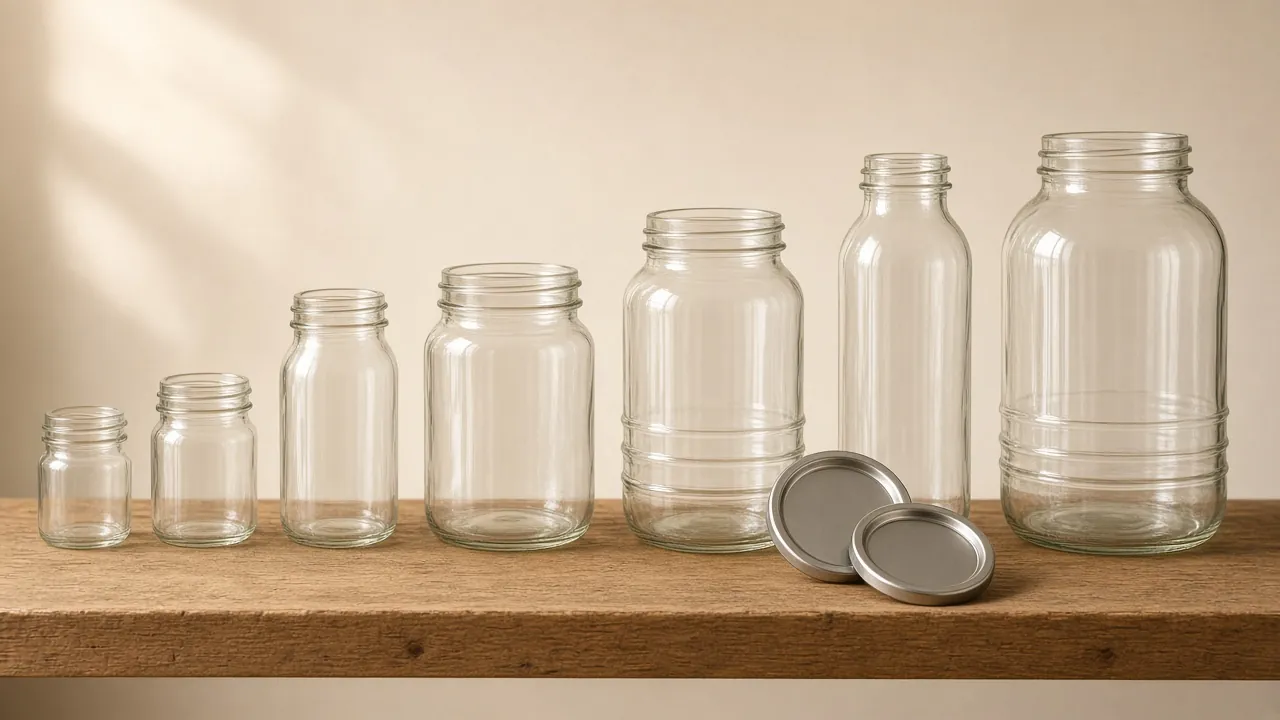
Canning jars come in two mouth widths and a handful of standard sizes. That sounds simple until you're in a store aisle choosing between a dozen boxes. This guide explains each size and opening, which lids fit, how jar size ties into processing time, and the jar-prep rules from the USDA Complete Guide to Home Canning as published by the National Center for Home Food Preservation (NCHFP).
The one rule that matters most
Use the jar size your tested recipe names. Processing times are worked out for specific jar sizes, because heat takes longer to reach the center of a bigger jar. NCHFP's processing-time guidance notes that quart jars generally need more time than pints in a boiling-water canner.
Don't size upNever put a recipe tested only for pints into quarts, or into half-gallons. If the recipe doesn't list a time for your jar size, there isn't a safe time to guess.
There's one helpful shortcut. In the USDA guide's tables, process times for ½-pint and pint jars are the same, and so are times for 1½-pint and quart jars (NCHFP). That applies to USDA tables. Other recipe sources may lay out their tables differently, so read the recipe in front of you.
Regular mouth vs. wide mouth
Every standard home-canning jar has one of two openings. NCHFP describes the standard (regular) jar mouth as about 2⅜ inches across and wide-mouth jars as about 3 inches, "making them more easily filled and emptied." Accessory makers often list the outer diameter of the threads instead. Masontops, for example, gives 2.75 in (7 cm) for regular and 3.38 in (8.6 cm) for wide (size guide).
| Regular mouth | Wide mouth | |
|---|---|---|
| Opening (NCHFP) | About 2⅜ in | About 3 in |
| Easiest for | Pourable foods: jams, jellies, sauces, juices, relish | Packed foods: whole or halved fruit, tomatoes, pickle spears, large pieces |
| Cleaning by hand | Harder to reach inside | Easier |
| Lids and bands | "Regular" size only | "Wide mouth" size only |
| Fermenting accessories | Widely available | Widely available; more room for weights |
Lids aren't interchangeable between the two widths. Because the two openings are standard, though, regular lids from one major brand generally fit another brand's regular-mouth canning jars. Check the box for compatibility.
Standard sizes and what they're for
NCHFP lists Mason-type home-canning jars in ½-pint, pint, 1½-pint, quart and ½-gallon sizes, plus regular-mouth decorator jelly jars in 8- and 12-ounce sizes.
| Size | Volume | Typical use | Notes |
|---|---|---|---|
| 4 oz (quarter-pint) | 4 fl oz | Jams, jellies, gifts | Not in USDA's standard size list; use only when your recipe allows it |
| Half-pint | 8 fl oz | Jams, jellies, relishes, salsa, pepper jelly | Same USDA process time as pints |
| 12 oz (jelly jar) | 12 fl oz | Jellies, sauces | NCHFP lists 8- and 12-oz regular-mouth jelly jars; follow your recipe's sizes |
| Pint | 16 fl oz | The workhorse: vegetables, salsa, pickles, fruit, meat | The most common size in tested recipes |
| Pint-and-a-half | 24 fl oz | Tall pickles, asparagus spears | Same USDA process time as quarts |
| Quart | 32 fl oz | Tomatoes, fruit, whole pickles, stock, green beans | Needs a tall canner for boiling-water processing |
| Half-gallon | 64 fl oz | Very acid juices only (e.g., apple and grape juice) | NCHFP: half-gallons "may be used for canning very acid juices." Not for general canning |
Choosing a sizePick based on how fast your household eats it. Once opened, a jar belongs in the fridge, so a quart of jam that takes a month to finish is worse than four half-pints.
How many jars fit in a canner?
Canner capacity is usually given in jars, and it depends on size and mouth width. NCHFP's general guidance is that most canners hold seven quart jars or eight to nine pints. Small pressure canners hold four quarts, and some large pressure canners hold 18 pints in two layers but still only seven quarts.
A concrete example: Presto's spec sheet for its 23-quart pressure canner (No. 01781) gives these capacities, and they show how much depends on method and mouth width:
| Jar | Pressure canning, regular mouth | Pressure canning, wide mouth | Boiling-water, regular mouth | Boiling-water, wide mouth |
|---|---|---|---|---|
| Half-pints | 26 | 16 | 13 | 8 |
| Pints | 20 | 16 | 10 | 8 |
| Quarts | 7 | 7 | 7 | 7 |
Plan your jar purchases around a full canner load of your favorite size, and remember that quarts need the tallest pot.
Lids: what fits and what's reusable
- Match lid size to the mouth: regular or wide.
- Use new flat lids every time. NCHFP says Mason jars can be reused many times "requiring only new lids each time."
- Bands are reusable when clean, dry and not rusted or bent. NCHFP recommends removing them from cooled, sealed jars before storage.
- Buy only about a year's supply of lids. NCHFP says the gasket compound in unused lids works well for at least 5 years from manufacture, and older lids may fail to seal.
Do jars need to be sterilized?
Often not. Per NCHFP's jar guidance:
- Sterilize empty jars for jams, jellies and pickled products that will be processed less than 10 minutes. Put the jars upright on the rack in a boiling-water canner, fill the canner and jars with hot (not boiling) water to 1 inch above the tops, and boil 10 minutes at elevations under 1,000 ft. Add 1 minute for each additional 1,000 ft.
- No presterilizing is needed for jars that will be pressure-canned, or for fruits, tomatoes and pickled or fermented foods processed 10 minutes or longer in a boiling-water canner.
- Either way, wash jars in hot water with detergent and rinse well, by hand or in a dishwasher. NCHFP notes that washing doesn't sterilize. Hard-water film can be removed by soaking jars for several hours in 1 cup of 5% vinegar per gallon of water.
Can I reuse store-bought jars?
NCHFP says most commercial pint- and quart-size mayonnaise or salad-dressing jars can be used with new two-piece lids for acid foods, but you should expect more seal failures and breakage. They have a narrower sealing surface and are tempered less than Mason jars. They're not recommended for pressure canning. Other commercial jars that can't take a two-piece canning lid (pasta sauce jars with one-piece lug caps, for example) aren't recommended for home canning at all.
Inspecting jars before each batch
- Run a finger around the rim. A nick or chip can stop a seal.
- Look for cracks and deep scratches. NCHFP warns that seemingly insignificant scratches can cause breakage in the canner.
- Retire jars that have been used for non-food purposes or that you can't identify as canning jars.
Storing filled jars
Jar size also affects how you store and use what you've canned. NCHFP's storage guidance covers it:
- Remove screw bands once jars have cooled, then wash, label (contents and date) and store the jars in a clean, cool, dark, dry place. NCHFP gives 50°F to 70°F as the best temperature range.
- Don't store jars above 95°F or near hot pipes, a range or a furnace, in an uninsulated attic, or in direct sunlight.
- For best quality, NCHFP advises canning no more than you'll use within a year, unless a specific food's directions say otherwise.
- Smaller jars mean less waste after opening, since an opened jar has to be refrigerated.
Our pick
Affiliate disclosure: As an Amazon Associate I earn from qualifying purchases. Buttons marked "Check it on Amazon" are affiliate links, so The Canning Shelf may earn a commission at no extra cost to you. Maker links are plain links. Picks are based on published specs, not payment. See our disclosure.
Ball Wide Mouth Pint Jars with Lids and Bands, 12-Pack (Model 66000ZFP)
Pints show up in the most tested recipes, and the wide mouth suits both packed vegetables and pickles. They also work with wide-mouth fermenting lids and weights.
- 12 × 16 oz wide-mouth jars, lids and bands included (Ball product page, checked Oct 31, 2026)
- Listed as made in the USA, BPA-free and freezer safe
- Also sold as a 32 oz quart 12-pack on the same page
Quick answers
Are wide-mouth jars better?
They're easier to fill and clean, which matters for packed foods. Regular mouth is fine, and cheaper per lid in many stores, for jams, sauces and juices. Your recipe's process time applies either way unless the recipe specifies a mouth style.
Can I can in half-gallon jars?
Only very acid juices such as apple and grape, per NCHFP. Don't use them for vegetables, tomatoes, fruit pieces or anything else.
Do 12-oz jars use pint times?
Use whatever your tested recipe says for that jar. If it doesn't list the 12-oz size, use a size it does list.
Related: Water-bath vs. pressure canning · Beginner equipment checklist
Sources
- NCHFP / USDA, Recommended Jars and Lids
- NCHFP / USDA, Selecting the Correct Processing Time
- NCHFP / USDA, How to Use Boiling Water and Pressure Canners
- NCHFP / USDA, Storing Home Canned Foods
- Presto, 23-Quart Pressure Canner spec sheet