Fermenting
Fermentation Weights, Airlock Lids and Crocks, Explained
How fermentation gear keeps vegetables under brine, what USDA/NCHFP guidance says about containers and weights, and how to choose between jar kits and stoneware crocks.
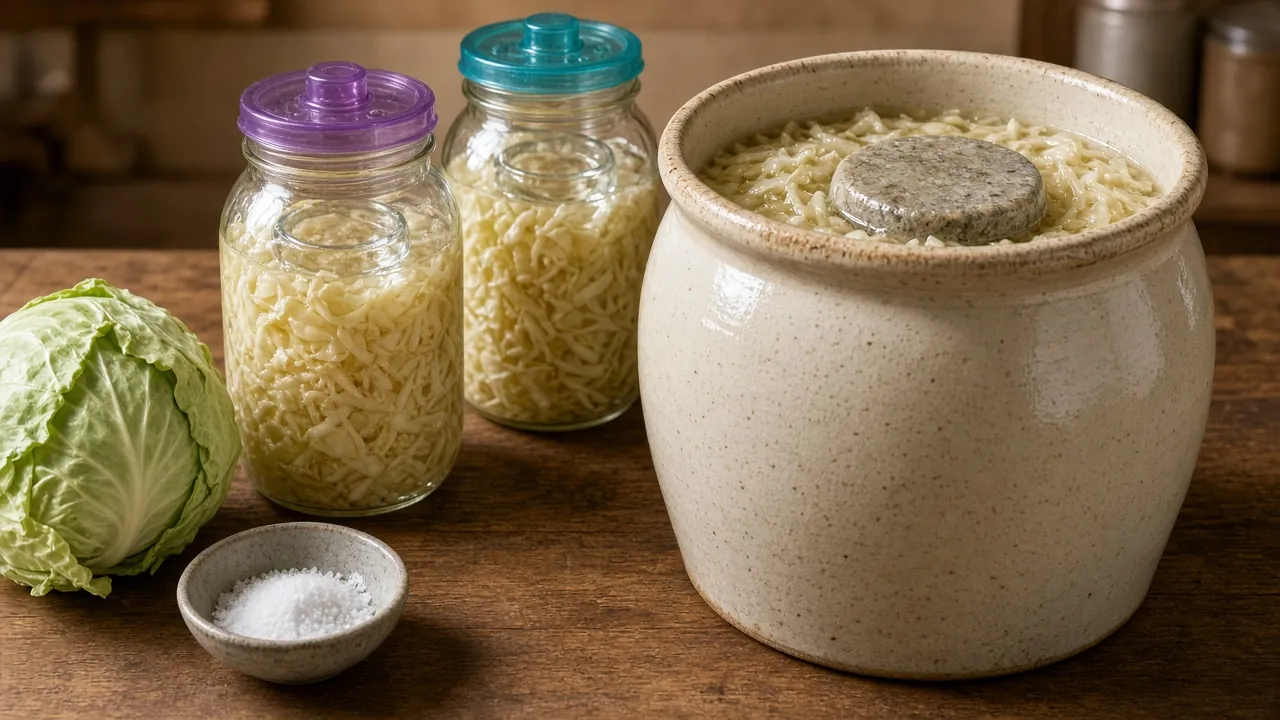
Sauerkraut, fermented dill pickles and kimchi-style vegetables don't need a canner. They need salt, time, the right temperature, and a way to keep the vegetables under the brine. Almost every piece of fermentation gear is a different answer to that last problem. This guide explains what each piece does and what the USDA guidance actually requires, so you can buy only what you need, or nothing at all.
The safety and method points below come from the National Center for Home Food Preservation (NCHFP), which republishes the fermenting sections of the USDA Complete Guide to Home Canning. This is an explainer of how common gear works, based on manufacturer specs. It's not a hands-on test report.
What all this gear is for
In a vegetable ferment, salt pulls juice from the vegetables to make a brine, and lactic-acid bacteria gradually acidify it. The gear exists to manage three things:
- Submersion. NCHFP says cabbage and cucumbers must be kept 1 to 2 inches under the brine while fermenting. Anything poking above it is exposed to air, and that's where problems start. Weights handle this.
- Gas. Fermentation makes carbon dioxide. Airlock lids let it out without letting much air in. A towel-covered crock simply lets it escape.
- Contamination. A clean cover keeps out insects and dust. NCHFP suggests a clean, heavy bath towel over the container opening.
What the USDA guidance says about containers
NCHFP's container page is short, and it's more permissive than a lot of gear marketing would suggest:
- Size: plan on a 1-gallon container for each 5 pounds of fresh vegetables. A 5-gallon crock suits about 25 pounds of cabbage or cucumbers.
- Material: stone crocks are traditional, but food-grade plastic and glass containers are excellent substitutes. Non-food-grade 1- to 3-gallon plastic containers can be used only if lined with a clean food-grade plastic bag. Never use garbage bags or trash liners.
- Mason jars: fermenting sauerkraut in quart and half-gallon Mason jars is "an acceptable practice, but may result in more spoilage losses."
- Weighting: use a plate slightly smaller than the opening, weighed down with 2 to 3 sealed quart jars filled with water. Or use a large, sealed food-grade plastic bag holding 3 quarts of water with 4½ tablespoons of salt. The salt means a leak won't dilute the brine.
- Cleaning: wash the container, plate and jars in hot sudsy water and rinse well with very hot water before use.
Zero-cost setupA food-grade container, a plate, a few water-filled jars and a towel is the USDA-described method. Everything you buy beyond that is about convenience, not safety.
Temperature and time (sauerkraut example)
The USDA sauerkraut recipe on NCHFP uses 3 tablespoons of canning or pickling salt per 5 pounds of shredded cabbage (¾ cup per 25 pounds). It gives these fermentation guidelines:
| Storage temperature while fermenting | What to expect |
|---|---|
| 70°F to 75°F (USDA recommendation) | Fully fermented in about 3 to 4 weeks |
| 60°F to 65°F | May take 5 to 6 weeks |
| Below 60°F | Kraut may not ferment |
| Above 75°F | Kraut may become soft |
The recipe also says that if juice doesn't cover the cabbage, you can add boiled and cooled brine (1½ tablespoons of salt per quart of water). If you weigh the cabbage down with a brine-filled bag, don't disturb the crock until fermentation is complete (when bubbling stops). If you use jars as the weight, check the kraut 2 to 3 times a week and remove scum if it forms.
When it's done, NCHFP says fully fermented kraut keeps tightly covered in the refrigerator for several months, or it can be canned in a boiling-water canner using the times in that recipe.
Follow a tested recipe for salt and timeSalt amount, temperature and fermentation time all affect safety and quality. Use the USDA/NCHFP recipes (sauerkraut, fermented dill pickles) or another research-tested source rather than improvising.
Fermentation weights
Weights sit on top of the vegetables to keep them under the brine. Your main options:
| Weight type | Best for | Pros | Watch out for |
|---|---|---|---|
| Plate + water-filled jars (USDA method) | Crocks, buckets, wide containers | Free; described by USDA/NCHFP | NCHFP: check 2–3×/week and skim scum |
| Brine-filled food-grade bag (USDA method) | Crocks and buckets | Conforms to the surface; a leak won't dilute the brine | Use food-grade bags only, never trash bags |
| Glass jar weights | Mason jars | Non-porous, easy to see through and clean | Glass can crack with sudden temperature changes |
| Ceramic / stoneware weights | Crocks, large jars | Heavy; often sold matched to a crock | Must match the crock size |
| Small jar or zip bag in a big jar | One-off jar ferments | Free | Fiddly; must still keep veg submerged |
Airlock and "pickle pipe" lids
Lids made for jar fermenting let carbon dioxide escape while limiting air coming in, so you don't have to "burp" jars by hand. There are three common styles:
- Waterless silicone valve lids, one-piece silicone with a one-way valve, held on with a regular screw band.
- Water airlocks, the small three-piece or S-shaped airlocks used in home brewing, set in a grommeted lid. They work, but you have to keep the water topped up.
- Integrated kits: a jar sold with its own silicone lid and airlock.
Fit matters. Jar fermenting lids come in regular-mouth and wide-mouth sizes. Masontops gives the outer mouth diameters as 2.75 in (7 cm) for regular and 3.38 in (8.6 cm) for wide (maker's size guide). Check which jars you own before you order.
Airlocks don't replace weightsAn airlock manages gas; it doesn't hold vegetables down. Even the airlock makers recommend pairing their lids with a weight.
Crocks
Stoneware crocks are the traditional choice for big batches. There are two main styles:
- Open (traditional) crocks, with a cover and usually split stone weights, used with a towel over the top. This is the setup described in the USDA guidance.
- Water-seal crocks, with a channel around the rim that you fill with water. The lid sits in it, so gas can escape and less air gets in.
Crocks are heavy and take floor or counter space, and NCHFP's 1-gallon-per-5-pounds rule tells you which size you need. If you put up a lot of cabbage or cucumbers at once, a crock is easier than a dozen jars. If you ferment a jar at a time, it's overkill.
Old crocksA crock that will hold acidic brine for weeks should have a food-safe glaze. With an antique or unmarked crock, you can't confirm that at home. A current crock whose maker states a lead-free, food-safe glaze, or a food-grade glass or plastic container, removes the guesswork.
Which setup should you choose?
| If you… | Start with | Approx. capacity logic |
|---|---|---|
| Want to try fermenting with no spend | Food-grade container or jar + plate/small jar + water-filled jars + towel | 1 gal per 5 lb vegetables |
| Ferment a jar or two at a time | Glass weights + waterless airlock lids for jars you own | Quart jar ≈ small batch; NCHFP notes more spoilage risk in jars |
| Want an all-in-one gift or starter | A fermenting jar kit with lid, airlock and weights | Check the kit's stated jar volume |
| Make big seasonal batches | A 2-gallon or larger crock with matching weights | 2 gal ≈ 10 lb vegetables by the NCHFP rule |
Our picks
Affiliate disclosure: As an Amazon Associate I earn from qualifying purchases. Buttons marked "Check it on Amazon" are affiliate links, so The Canning Shelf may earn a commission at no extra cost to you. Maker links are plain links. Picks are based on published specs, not payment. See our disclosure.
Picks are based on the makers' published details, checked October 31, 2026. Stock and prices change, and when we checked, Masontops showed Pickle Pebbles as sold out.
Masontops Pickle Pipe Fermentation Airlocks (4-pack)
This is a simple waterless option for people who already own Mason jars.
- One-piece silicone airlock with a one-way valve; secured with your own screw band (not included), per Masontops
- Sold in regular- and wide-mouth sizes
- BPA- and phthalate-free silicone; dishwasher safe; Masontops says to pinch them before first use to activate the valve
Masontops Pickle Pebble Fermentation Weights (4-pack)
These glass weights sized for jar mouths fill the job the airlock can't: keeping vegetables under the brine.
- Lead-free, food-grade soda-lime glass with finger grips (maker's page)
- Regular- and wide-mouth sizes; Masontops says they also fit Fido jars
- Masontops says they're not for boiling or heat processing, and to avoid sudden temperature changes
Kilner Fermenting Set
This kit has everything for one large jar of kraut in one box. It's a sensible gift.
- Kilner USA lists a 102 US fl oz fermenting jar, silicone lid, air lock, 2 ceramic stones and an instruction/recipe booklet
- Dishwasher safe; Kilner says not to pour boiling water into the jar
Ohio Stoneware 2-Gallon Traditional Style Starter Kit (#01206)
This is an American-made traditional crock kit. By NCHFP's 1-gallon-per-5-pounds rule, 2 gallons suits about 10 pounds of cabbage.
- Crock with cover and weights, per Ohio Stoneware's product list (#01206)
- Ohio Stoneware's catalog describes lead-free, food-safe glazes and two semi-circular stone weights
- The maker also lists 2- and 3-gallon water-seal starter kits (#12157, #11709)
Care and cleaning
- Wash containers, plates, weights and jars in hot sudsy water and rinse with very hot water before each batch, as NCHFP directs.
- Follow each maker's care notes. For example, Masontops recommends laying silicone lids flat to store so they don't warp, and warns against moving glass weights from a hot dishwasher straight into cold brine.
- Store finished ferments covered in the refrigerator. If you want shelf-stable kraut, can it using NCHFP's tested boiling-water times.
Sources
- NCHFP / USDA, Suitable Containers, Covers, and Weights for Fermenting Food
- NCHFP / USDA, Sauerkraut
- NCHFP / USDA, Dill Pickles (fermented)
- NCHFP, Problems with Fermented Pickles